Although I was born in Argentina and carnivory runs deep through my veins, I love pulses (legumes) more with each passing day, due to their flavor, their versatility and their great potential for sustainable production. I’m especially curious about chickpea flour (besan in India, shiro in Ethiopia) with its high-protein and low glycemic index awesomeness. Here’s a recipe, a variant of the one I found HERE (but which originally came from this exciting book):
Ingredients
For the broth
- Water (or your favorite vegetable/chicken/meat/bone broth): 4 cups (use only 2 if using the chile ancho’s soaking water)
- Garlic: 2 large cloves, peeled and chopped/sliced fine (no need to chop if using chile ancho and/or onion)
- Olive oil, extra virgin: 1/4 cup
- Cumin, ground: 2 teaspoons. Can also add a few cumin seeds.
- Salt: 1 teaspoon
- Optional: Onion, small, 1/2-1, cut coarsely.
- Optional: Chile ancho, or other dried, colorful, not-too-hot pepper, rehydrated ahead of time (at least 30 minutes) in 2 cups of water. (Keep the water!)
For the besan
- Water, cold, 2 cups
- Chickpea flour / besan / shiro: 1 cup
For the finish
- Green onion (scallion), thinly sliced: 1
- Lemon juice: 2 lemons
- Black pepper, to taste
Procedure
For the broth
- If you’re using the chile ancho, squeeze liquid back into the soaking water, split the pepper open, remove the seeds and stem, chop the pepper into a few pieces, put it in a food processor, and pulse a couple of times. You’ll want to use the soaking water as part of your 4 cups of broth, but remove the seeds first.
- If using onion, add to the food processor, along with the garlic. Pulse a few more times until the mix is still a little chunky. If you’re not using the chile ancho or the onion, just skip to step 3 and chop your garlic fine.
- Put about a tablespoon of the olive oil in a 3-quart saucepan over medium-low heat. When hot, sauté the garlic, onions, pepper and cumin for 2-5 minutes so the flavors are released. You don’t want any of it to burn, or your soup will taste bitter.
- Add the rest of the oil, the rest of the water / broth (including the chile soaking water if you used that, for a total of 4 cups) and the salt.
- Bring it to a boil over medium heat, while you move on to the next step.
For the besan
- Put the chickpea flour in a mixing bowl, then add about half the reserved cold water, mix/whisk, and keep adding the water until you have a smooth mixture.The idea here is simple: If you try to add the chickpea flour directly to the boiling broth, your soup will be irremediably lumpy, but you can get a smooth, lump-free mixture by combining the flour and cold water mixture.
- After the broth in the saucepan has boiled for about a minute, whisk the flour mixture into it. Stir a few times while the mix reaches a boil again. It will thicken (to the consistency of heavy cream) after about 2-3 minutes of boiling.
- If your soup gets too thick for your liking, mix in a little more water.
For the finish
- Stir in the lemon juice
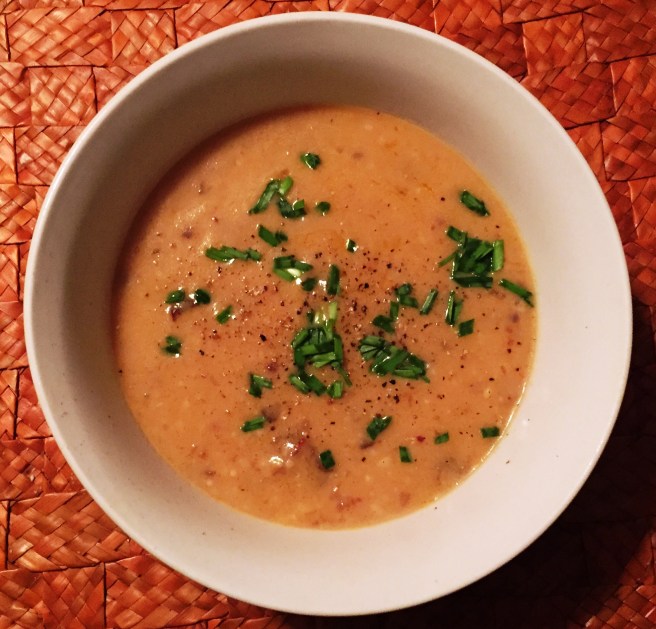
- Ladle into bowls, and serve topped with the green onions and black pepper to taste.
For me, this recipe has huge potential: it’s very fast to prepare, filling and nutritious to boot. The challenge is to make the initial broth flavorful enough to be interesting. My use of the chile ancho (a dried ripe poblano pepper) is a move in that direction, because chile ancho provides interesting color and flavor without a lot of heat. The onions are another step in the same direction. You may want to explore other options like soaking kelp (kombu) or shiitake mushrooms in your water to add extra flavor, as well as starting with vegetable, chicken or bone broth instead of water.
 R. Andres Ferreyra