Moth Beans

About 20 years ago I was exposed to crop simulation modeling. I was instantly hooked. Over the next few years I worked intensely on simulating the effect of water stress on peanuts and other legumes. I’ve remained a sucker for drought-tolerant pulses ever since.

I recently ran into moth beans (Vigna aconitifolia, pronounced “moad”) at a great Indian grocery store in St. Louis. I learned that they are highly drought-tolerant, and couldn’t resist the urge to buy some and cook them. I found several recipes online; what follows was taken from HERE, where there are step-by-step instructions with pictures.

The results are great: moth beans have a nutty flavor and a fun (rather firm) texture. It was interesting to sprout the beans ahead of cooking them. It took about a day and a half for mine to start sprouting (I bundled the soaked beans in cheesecloth and hung the bundle from the pot rack over our kitchen counter)

Ingredients

  • Moth beans (matki): ½ cup
  • Oil: 1 tablespoon
  • Cumin seeds: 1 teaspoon
  • Onion: ⅓ cup, chopped
  • Green chilies: 1, finely chopped
  • Tomato: ½ cup, chopped
  • Coriander powder: ½ teaspoon
  • Cumin powder: 1 teaspoon
  • Turmeric powder: ¼ teaspoon
  • Red chili powder: 1 teaspoon
  • Water: 1 ¼ cups
  • Lemon juice: 1 ½ teaspoons
  • Cilantro or coriander leaves: few, finely chopped

Procedure

  1. Wash the beans under running cold water until the water runs clear.
  2.  Soak the beans in water for at least 4 hours, preferably overnight. Discard the water and keep the drained beans aside.
  3. Alternatively, sprout the beans after soaking them (keeping them in a well-ventilated bundle at room temperature for about 36 hours, and misting or wetting them when they dry out.)
  4. Heat the oil in a pressure cooker (alternatively a conventional pot such as an enameled Dutch oven) on medium heat.
  5. Once the oil is hot, add the cumin seeds and let them sizzle.
  6. Add the onion and green chili plus a little salt. Sauté until the onions get translucent.
  7. Mix in the tomatoes; add all the dry spices and remaining salt. Sauté for a minute.
  8. Add drained beans and the water. Cover the pressure cooker and let it whistle 5-6 times on medium heat. (Alternatively, boil in a Dutch oven for about an hour.)
  9. Turn off the stove and let the pressure reduce by itself.
  10. Open the lid, add lemon juice and cilantro.
  11. Mix well and serve (e.g., on white rice).
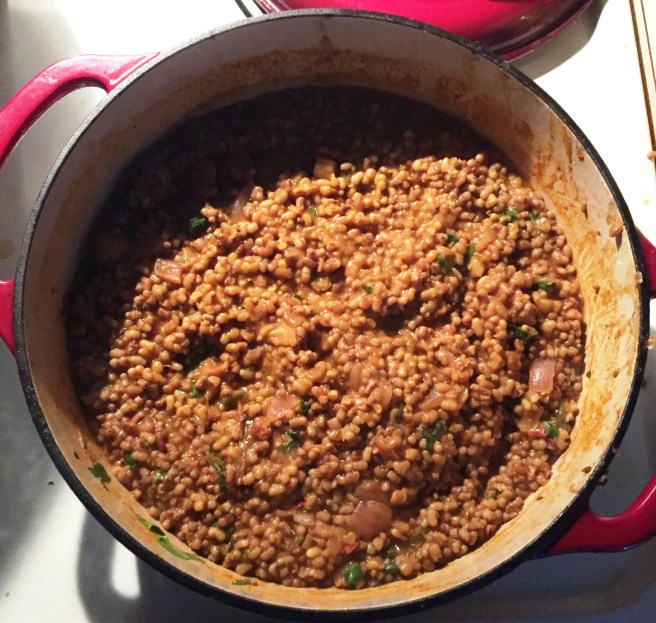
Moth beans.jpg

A pot of moth beans (recipe quadrupled–you can never have too much of these!)

New England Baked Beans

I realized that July is “National Baked Bean Month” in the United States, which is both amusing, and a call to action! I like beans in general and baked beans in particular, but I don’t prepare them nearly as often as I should. Below I include a recipe from the American Dry Bean Council; I’ll prepare it as soon as I get back home from a conference this week.

See pulses.org for more great bean ideas and recipes. Additionally, 2016 is the International Year of Pulses!)

Ingredients

  • Navy beans (dry): 1 pound (can replace with 4 cans of beans)
  • Bacon, cubed: 8 ounces
  • Onions, chopped: 2 cups
  • Garlic, minced: 2 teaspoons
  • Molasses, unsulphured: 1/3 cup
  • Light brown sugar, packed: 1/3 cup
  • Mustard, prepared: 2 teaspoons
  • Mustard, dry: 1/2 teaspoon
  • Allspice, ground: 1/4 teaspoon
  • Bay leaves: 2
  • Salt: 2 teaspoons
  • Pepper: 1 teaspoon

Procedure

  1. Place beans in large saucepan with enough water to cover by 2 inches; heat to boiling and boil 2 minutes. Let stand, covered, 1 hour; drain.
  2. Return beans to pan with enough water to come to the top of the beans; heat to boiling. Reduce heat and simmer, covered, until tender but not soft, 30 to 40 minutes.
  3. Preheat oven at 250 degrees.
  4. Transfer beans and liquid into large pot or 3 quart casserole.
  5. Stir bacon and remaining ingredients into beans.
  6. Bake, covered, for 1 hour. (1/2 hour if using canned beans.)
  7. Uncover and bake until desired thickness, 4 – 6 hours, stirring every hour.

Cornbread using self-rising cornmeal

I live in Murray, Kentucky, and I’m very interested in foodways. Needless to say, when I ran into the book A Culinary History of Kentucky: Burgoo, Beer Cheese and Goetta at the Golden Pond Visitor Center in nearby lovely Land Between the Lakes, I snapped it up.

The book mentions Weisenberger Mills (near Lexington) as a company that makes the best grits in Kentucky. I love grits, so I bought some from Weisenberger’s online store; I also bought some self-rising cornmeal mix to experiment with. They are both delicious! I reproduce the corresponding cornbread recipe (the original is HERE) below for your inspiration (and my own convenience).

Ingredients

  • Self-Rising Cornmeal Mix: 1 3/4  Cups
  • Sugar: 1 teaspoon (omit if using sweet milk)
  • Egg: 1
  • Buttermilk: 1 ½ Cups (can replace with sweet milk, see sugar above)

Procedure

  1. Preheat muffin or stick pans while preheating oven to 500 degrees F (260 C).
  2. Mix dry ingredients then add beaten egg.
  3. Pour in buttermilk, mix.
  4. Fill pans after a generous greasing.
  5. Bake 15 minutes at 500 deg. F (260 C) oven.

Steamed Dhokla

From: NDTV.COM (Correct amounts). Written instructions from another NDTV page (Incorrect amounts). Authors: Aditya Bal & Devanshi
Servings: 2
Time: 5-10 minutes prep time, about 30 minutes cook time.

Ingredients, Dhokla (Correct amounts)

  • 1 cup besan (chickpea flour )
  • 1 tsp citric acid
  • 1+ tsp sugar
  • Salt to taste
  • Pinch of turmeric
  • Water
  • 1 tsp fruit salt or baking powder, dissolved in water

Ingredients, Tadka (Correct amounts)

  • 1 Tbsp oil
  • 1/2 Tbsp mustard seeds
  • Red chilies
  • 7-8 curry leaves

Method

  • In a bowl mix the besan, citric acid, salt, sugar and turmeric. Add water and make it into a smooth batter with medium-thick consistency.
  • Grease a steaming tin with a little oil
  • In a glass mix the fruit salt or baking powder with some water. Incorporate this quickly into the dhokla mixture.
  •  Pout the mixture into the steaming tin. Steam for about 15-25 minutes or until cooked (Time needed depends on depth of the pan.)
  • Heat the oil in a skillet. Add the mustard seeds, curry leaves and red chilies. Let them pop and cook until the flavors are released.
  • Pour the tadka over the prepared dhokla.
  • Cut into pieces and serve.

Notes

  • The proportions shown in the original webpage are way off: I made a batch with those proportions and it was off-the-charts tart, the result of adding a TABLESPOON of citric acid to a cup of chickpea flour! The video has better proportions.
  • Someday I’ll try a fermented version without the citric acid + fruit salt chemistry.
  • The dhoklas went great with a tamarind chutney.

20160507 Dhokla.jpg

Not a very glamorous shot, but it does look better when cubed!

Besan Khandvi

From: Aadhar Restaurant, Ahmedabad (Presented HERE)
Servings: 4
Cook time: 30

Ingredients, khandvis:

  • 1 cup besan (chickpea flour)
  • 3 Tbsp curd (yogurt)
  • Salt, to taste
  • 1 tsp turmeric
  • 1 tsp red chili powder
  • Hing (asafoetida), a pinch
  • 3 cups water
  • Oil, to grease

Ingredients, tempering:

  • 2 tsp oil
  • 1 tsp mustard seeds
  • 2 tsp sesame seeds
  • 2 chopped green chilies
  • 2 Tbsp water
  • Coriander leaves, to garnish
  • Red chili powder, to garnish

Procedure, khandvis:

  • In a kadhai or wok mix together besan, curd, salt, turmeric, hing, red chilli powder.
  • Add 3 cups water gradually to make a batter.
  • Now turn on the heat (medium flame) and start stirring the batter continuously.
  • Once the batter reaches a thick consistency, turn off the heat.
  • Grease the back side of the plates with a little oil and spread the thickened batter. (Make sure the batter applied is not too thick or the khandvis won’t roll.)
  • Let them cool for 10 minutes.
  • Cut strips with a knife and roll.

Procedure, tempering:

  • In a small pan add oil, mustard seeds, sesame seeds, chillies and water.
  • Pour over the  khandvi
  • Garnish with coriander leaves and red chill powder.